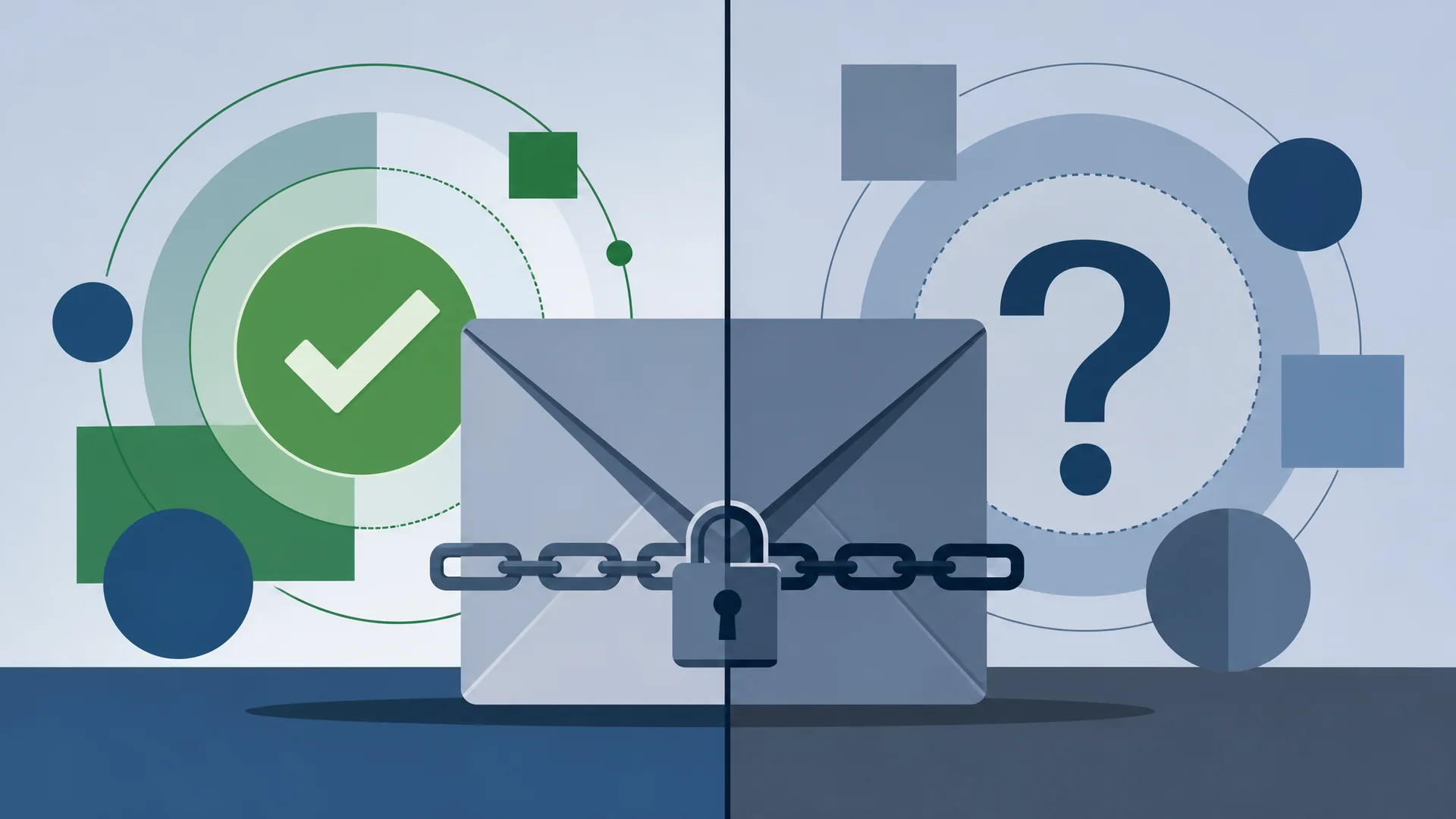
An ARC chain can validate perfectly and still be lying to you about what matters. That sounds like a contradiction, but it's the entire premise of ARC's Trust Gap, the space between "this chain is cryptographically intact" and "this chain came from someone you should trust." Most treatments of ARC stop at the first claim. This one is about the second.
If you haven't yet worked through the mechanics, the AAR, AMS, and AS header trio, the seal-and-forward model, how ARC survives mailing lists and relays that break DKIM, the ARC protocol mechanics explained overview covers that ground. This article assumes you know how ARC works and asks the harder question: why knowing how it works doesn't tell you whether to believe it.
What 'ARC Passed' Actually Verifies, and What It Doesn't
When a mail system reports "ARC: pass," it's making a narrow, specific claim. It's saying the chain of ARC seals attached to a message is internally consistent, each hop's signature validates against the previous state, and no link in the custody chain has been tampered with or broken. That's a real, useful, verifiable fact.
What it is not saying: that the message is legitimate, that the sender is who they claim to be, or that any intermediary in that chain deserves your confidence. ARC records what happened at each hop. It does not judge whether what happened was okay.
ARC Chain Validation vs. Trust: The Core Distinction
This is worth stating plainly, because it's the single most misread concept in ARC deployments: chain validation is a math problem, trust is a policy problem, and ARC only solves the first one.
Validation asks: "Did every hop sign what it claims to have seen, in the order it claims, without alteration?" A receiver's mail server can answer that question mechanically, the same way it verifies a DKIM signature, check the cryptography, confirm the sequence, done.
Trust asks a completely different question: "Should I believe what hop #2 says it saw?" That question has no cryptographic answer. It requires a judgment about the intermediary itself, its history, its security posture, whether it's the kind of relay that gets compromised or abused. RFC 8617, the specification that defines ARC, is explicit about this boundary: it describes ARC as a mechanism for preserving authentication signals across intermediaries, not as a trust or reputation system. The spec deliberately leaves trust decisions to the receiver. That's not an oversight. It's a design choice, and it's the choice that creates everything discussed below.
Why ARC Is Not Authentication
Call it what it is: ARC is a courier service, not a notary. Authentication mechanisms like SPF, DKIM, and DMARC make assertions about a message's origin and integrity that a receiver can trust independently, because they're anchored to domain-level cryptographic proof or published policy. ARC doesn't make that kind of assertion. It carries forward the record of what those mechanisms found at an earlier hop, sealed so a later receiver can see it wasn't altered in transit.
That's genuinely useful. Without it, a message forwarded through a mailing list would lose its original SPF and DKIM results the moment the list server rewrote headers or changed the envelope sender. ARC preserves that history. But preserving a record of a prior finding is not the same act as producing a new one. If you want the underlying mechanics of what ARC is actually forwarding, how SPF, DKIM, and DMARC actually work together lays out the authentication layer ARC depends on but doesn't replace.
Reading the ARC-Seal Header: What It Signs and What It Skips
Look at what each ARC header actually attests to, and the gap becomes concrete.
- ARC-Authentication-Results (AAR) records what SPF, DKIM, and DMARC found at that hop. It's a snapshot, not a re-verification by the next hop.
- ARC-Message-Signature (AMS) signs the message content as that hop saw it, proving nothing was altered between arrival and forwarding at that specific step.
- ARC-Seal (AS) signs the entire set of prior ARC headers, including previous seals, binding the chain together and proving the sequence hasn't been reordered or spliced.
Every one of these headers attests to hop integrity, that the data wasn't tampered with in transit. None of them attests to sender legitimacy, and none of them vouches for the intermediary that added the seal. A malicious or compromised relay can seal a message flawlessly. The seal proves the relay didn't corrupt the data on the way through. It says nothing about whether the relay should have forwarded that message at all.
How a Technically Valid ARC Chain Can Still Carry a Malicious Payload
Here's where the trust gap stops being theoretical. Picture a message forwarded through a mailing-list server that's been compromised, not spoofed, not misconfigured, actually taken over by an attacker who now controls what it relays and how it seals.
That server can produce a fully valid ARC chain. Correct AAR, correct AMS, correct AS headers at every hop, all cryptographically sound. A receiving mail system checks the chain, confirms it validates, and sees "ARC: pass." Nothing about that check catches the problem, because the problem isn't in the chain's integrity. It's in the judgment of what the compromised hop chose to forward and how it chose to represent it. The ARC mechanism has no opinion on that. It was never built to have one.
ARC Spoofing Risk in Practice
This is the practical shape of ARC spoofing risk: not a broken cryptographic chain, but an intact one wrapped around a payload the chain never evaluated. The attacker doesn't need to defeat ARC's math. They need control of a hop that other receivers have chosen to trust, or a hop that nobody has vetted at all, because ARC doesn't require vetting to participate.
This is precisely why "ARC passed" can't function as a standalone verdict. A validated chain tells you the record of the journey is intact. It tells you nothing about whether any hop along that journey was a safe place for the message to have been.
The Missing Piece: ARC Sealer Trust Lists
If ARC won't tell you whether to trust an intermediary, something has to. That something is a sealer trust list, a receiver-maintained record of which ARC-sealing domains it's willing to treat as credible signal sources.
Why Receivers Must Maintain Their Own Trust Lists
ARC has no built-in registry of trustworthy sealers. There's no central authority certifying that a given mailing-list platform, forwarding service, or gateway is safe to rely on. That decision falls entirely to the receiving system, and it has to be made and maintained locally, hop by hop, sealer by sealer.
In practice, a mail system has to answer a set of operational questions before it can lean on an ARC pass at all. Which domains do we recognize as legitimate sealers? What's our basis for that recognition, a business relationship, a track record, a manual review? What happens when a sealer we trusted gets compromised, and how quickly do we find out? None of this is handled by the protocol. All of it is handled by whoever operates the receiving mail system, and if they haven't built that list, an "ARC: pass" result is functionally meaningless as a trust signal. It's just a statement that the math checked out.
Why This Slows Enterprise ARC Adoption
This operational burden is the real reason enterprise ARC adoption has moved more slowly than the protocol's design would suggest it should. Standing up ARC checking is comparatively easy, it's a header-parsing and signature-verification problem, well-documented and supported by mainstream mail platforms. Standing up a trust list is a governance problem, and governance problems don't resolve with a configuration change.
Security teams have to decide who counts as a legitimate sealer, build a process for vetting and revoking that status, and accept ongoing maintenance as sealers' security postures change over time. That's a very different kind of project than turning on a validation check, and it's one many organizations haven't fully funded or staffed. The result is that a lot of enterprise ARC deployments run in a partial state: checking chains, logging results, but not yet folding sealer trust into automated filtering decisions, because nobody has finished building the list that would make that safe. Large mailbox providers that support ARC, including Gmail and Microsoft 365, describe it in their own sender documentation as informational input to spam and spoofing filters rather than as an independent authentication result. That framing is deliberate, and enterprise security teams rolling out DMARC enforcement routinely misread it as a stronger guarantee than it is.
The IETF Has Arrived at the Same Diagnosis
This governance gap isn't just an operational observation from the field, it's now the IETF's own stated reasoning for reconsidering ARC's future. On April 22, 2026, the DMARC working group published draft-ietf-dmarc-arc-to-historic-00, proposing to reclassify RFC 8617 as Historic. The draft's central argument is the same trust gap this article has been walking through: ARC's chain-of-custody signal is only as trustworthy as the receiver's sealer trust list, and there's no standardized way to build or share that list across the open internet. The working group cites limited real-world adoption, roughly 10,000 domains observed sending ARC-signed mail since 2019, as evidence the ecosystem never reached the governance maturity the design assumed.
This doesn't change anything in the checklist below. Gmail and Microsoft 365 still evaluate ARC chains in production today, and the sealer trust list problem still needs to be solved locally by any receiver who wants ARC results to mean something. But it's worth knowing, when you're arguing internally for the governance investment a real trust list requires, that the body which wrote the protocol has independently concluded the gap is serious enough to reconsider standardizing it further. That's not a reason to ignore ARC results in the field today. It is a reason not to treat trust-list-building as a problem ARC's future evolution will solve for you.
Interpreting ARC-Authentication-Results Headers Like an Analyst
None of this means ARC is useless in forensic triage. It means it has to be read the way an analyst reads any piece of corroborating evidence: in context, cross-referenced, never taken alone.
When you're working through a header trace and you hit an ARC-Authentication-Results header, treat it as a record of a claim, not a verdict. Ask what the original SPF and DKIM results were at each hop, whether the sealing domain is one your organization has actually evaluated, and whether the chain's story is consistent with everything else in the header trace, Received lines, Return-Path, the message's actual routing history. If you haven't built the habit of reading raw headers line by line, how to read raw email headers step by step is the place to build it before you try to layer ARC interpretation on top.
ARC and DMARC Interaction: Reading the Two Together
The interaction between ARC and DMARC is where this matters most in practice, because DMARC enforcement is exactly the scenario ARC was built to rescue, a legitimately forwarded message that fails DMARC only because an intermediary altered it in transit.
Does a passing ARC result override a failing DMARC check? No. Not on its own, and not automatically. What ARC provides is evidence a receiver can use to decide whether to override a DMARC failure, specifically, evidence that the message passed authentication at an earlier hop, before a trusted intermediary made changes that broke it. Whether to act on that evidence is a local policy decision, and it should only be made when the sealing domain is on a trust list the receiver actually stands behind. An ARC pass from an unvetted or unknown sealer, sitting next to a DMARC failure, is not a reason to deliver the message. It's a reason to look harder. For the mechanics of that override decision in practice, reading the Authentication-Results header during DMARC failures walks through how the two signals should actually interact at the filtering layer. And because ARC's AAR field is only forwarding an earlier DKIM result rather than re-verifying it, any ARC-related DMARC failure investigation eventually leads back to the original signature, which is where diagnosing DKIM signature verification failures becomes the next stop.
This is the same standard applied across this site's header-analysis material: "ARC passed" is one data point in a forensic read, never a pass/fail verdict on its own.
A Practitioner Checklist for Trusting (or Not Trusting) an ARC Chain
When an ARC chain shows up in a header trace, run through this before you act on it:
- Confirm the chain actually validates. Broken chains are a different, simpler problem, this checklist assumes the cryptography checks out.
- Identify every sealing domain in the chain. Not just the last one, every hop that added an AS header.
- Check each sealer against your trust list. If you don't have one, that's the gap to close before ARC results can inform automated decisions.
- Compare the ARC-carried SPF/DKIM results to the message's current state. Consistency across the chain matters more than any single hop's result.
- Never let an ARC pass silently override a DMARC failure. Treat it as a factor in a manual or policy-based override, not a bypass.
- Cross-reference against Received headers and routing history. A chain's story should match the message's actual path.
- Log unknown or newly-seen sealers for review. An unfamiliar sealer isn't automatically malicious, but it's automatically unverified.
An ARC chain is a record, not a reference. Reading it well means treating "pass" as the start of an investigation, not the end of one, and building the sealer trust judgment ARC was designed to leave in your hands. For the full methodology behind that kind of header-level forensic read, full delivery path and header forensics covers the broader tracing discipline this checklist draws from.