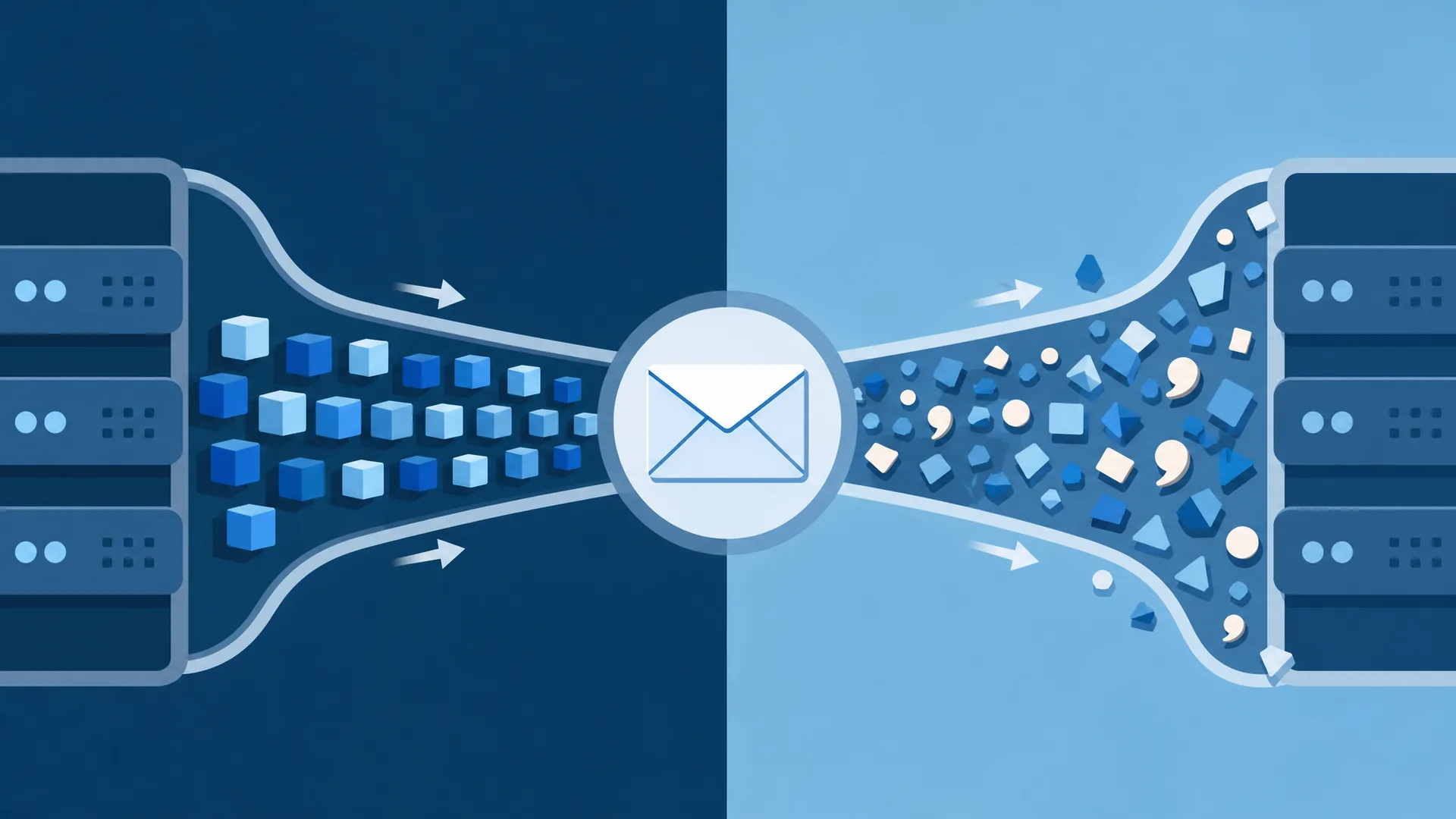
Search "email deliverability guide" and you get a hundred blog posts telling marketers to warm up their IP and avoid spam trigger words. Search for something built for the people who actually run mail servers, and you get nothing. That gap is exactly what an email reference book for engineers is supposed to fill: a single source that treats SPF records, Received chains, and SMTP response codes as the primary subject, not a sidebar.
This article walks through what that reference actually covers, who it's for, and how it holds up against the scattered vendor docs and forum threads engineers currently stitch together to do their jobs.
Why Engineers Need a Dedicated Email Engineering Book (Not Another Marketing Guide)
Most content about email exists to help a marketing team hit the inbox instead of the spam folder. That's a legitimate problem, but it's not an engineering problem. It doesn't tell you how a receiving server sequences an SPF check against a DKIM signature. It doesn't tell you why a Received header chain has six hops instead of three.
Engineers, deliverability specialists, and sysadmins need something different: a technical email book that treats headers, protocols, and failure modes as first-class material, written at the depth a whiteboard conversation between two senior engineers would go.
What Generic Deliverability Content Leaves Out
Marketing-oriented guides tend to stop at "set up SPF, DKIM, and DMARC" without explaining how those three mechanisms interact during actual mail transfer. They rarely dissect a raw header block. They rarely walk through an SMTP error code line by line. They almost never touch ARC or BIMI in any technical detail.
Most engineers can name SPF, DKIM, and DMARC. Fewer can explain how a receiving server actually sequences those checks against a raw header block. That gap between naming a standard and reading its evidence in a live header is exactly what a practitioner-grade reference needs to close.
Inside an Email Infrastructure Reference: What 15 Chapters Actually Cover
Email Decoded is structured as 15 in-depth chapters. It walks practitioners from email's ARPANET origins through SPF, DKIM, DMARC, ARC, and BIMI, and then past the point where most references stop — to DMARCbis, which replaced the original DMARC specification in 2026, and to DKIM2, the next-generation signature work still in development at the IETF. A companion site carries the same material into quick-lookup form: a complete header reference, SMTP codes decoded, an RFC tracker, and a DMARCbis checklist. It reads like an email infrastructure reference should: sequential, cumulative, and built so each chapter assumes you've absorbed the last one.
From ARPANET to Modern Standards
The book opens with history, and that's a deliberate choice, not padding. Understanding why SMTP has no built-in authentication explains why SPF, DKIM, and DMARC had to be bolted on decades later as separate, sometimes awkward, layers.
That historical grounding also explains oddities practitioners still hit today. The @ sign is in every address you will ever debug because one engineer picked an unused key on a Teletype keyboard in 1971. Line length still tops out where it does because a 1982 specification named a number every receiver had to accept, not because any machine could not hold more. Knowing why a rule exists is often the fastest way to know how strictly to read it.
That same historical spine is what lets the book end the chapter in the present tense rather than in 2019: DMARC's original specification was obsoleted in 2026, and the signature layer that replaces ARC's chain-of-custody idea is being drafted right now.
Chapter Map: Headers, Auth, MIME, Forensics, Troubleshooting
Across its 15 chapters, the book covers:
- Email history and the evolution of SMTP as a standard, through DMARCbis and DKIM2
- The full delivery path, from the sender's click to the final mailbox
- Envelope versus header addressing — the two identities every message carries, and why they disagree
- Message structure and header field reference, including obscure and vendor-specific fields
- SPF, DKIM, and DMARC mechanics, checked in sequence
- ARC and BIMI as advanced authentication topics, with an honest account of where ARC stands now
- MIME structure and multipart message trees
- Transport and content encryption — TLS, MTA-STS, DANE, S/MIME, and PGP
- Spam scoring headers, and how filters actually reach a verdict
- Inbound mail gateways and the filtering pipeline
- SMTP response codes and what each class actually signals
- Forensic tracing through Received chains
- Symptom-based troubleshooting playbooks for sysadmins
That range is what separates an email protocols book from a single-topic guide. It covers the delivery path end to end, not just one link in the chain.
Email Header Analysis and Forensic Tracing, Explained in Depth
Headers are where most delivery mysteries get solved, or missed entirely. A message that looks suspicious in the inbox often has an obvious explanation once you read its Received chain and Authentication-Results field in order.
The book's forensics chapter treats a header block as a piece of evidence, not decoration. It teaches readers to reconstruct a message's actual path, hop by hop, and to spot where that path doesn't match the story the From field is telling.
Reading a Real Header Block Line by Line
A dissected header block showing Received chain hops, Authentication-Results, and a forged From field shows how forensic tracing separates a spoofed message from a legitimately delayed one. The same six lines can mean "this is phishing" or "this is a slow relay." The difference is entirely in reading order and timestamp math.
This is the kind of email header reference material a five-minute blog post can't cover properly, because the skill is in the walkthrough, not the definition. For readers who want to see the method applied to a real specimen, there's a full forensic header analysis walkthrough that mirrors this chapter's approach.
SPF, DKIM, and DMARC Explained, Plus ARC and BIMI for Full Coverage
SPF checks the sending server. DKIM checks the message signature. DMARC asks a stricter question: did at least one of those two checks pass, and did the domain it passed for match the domain the recipient actually sees in the From line — either exactly, or, under DMARC's default relaxed mode, at the organisational-domain level. Explained separately, each is simple. Explained as a sequence a receiving server actually runs, the interactions get subtle fast, and that sequence is where most engineers' knowledge thins out.
The book treats these three mechanisms as one system, walking through how a real receiving server evaluates them together rather than as isolated checkboxes. For a deeper look at that interaction, how SPF, DKIM, and DMARC actually work together covers the same ground the chapter builds on.
It doesn't stop there. ARC is covered as designed — the mechanism meant to preserve authentication results across forwarding hops — and then covered honestly, because in April 2026 the IETF's DMARC working group proposed reclassifying it as Historic. The book explains why: cryptographic validation was never the hard part, and why ARC's cryptographic validation isn't enough on its own is the limitation most guides skip because it complicates a tidy pitch. The chapter then does what almost no other reference does yet — it carries the story forward to DKIM2, the successor now in active development at the IETF, which folds the chain-of-custody idea directly into the signature. BIMI gets similar treatment, including BIMI's DNS dependency chain, which is the reason so many BIMI rollouts silently fail before a single logo ever appears in an inbox.
Why Authentication Alone Doesn't Guarantee Delivery
Passing SPF, DKIM, and DMARC doesn't guarantee inbox placement. Reputation, content filtering, and receiving-server policy all sit downstream of authentication and can still block or route a message to spam.
This is exactly the kind of nuance an email authentication guide book needs to state plainly, instead of implying that three green checkmarks solve delivery on their own — which is why spam scoring and the inbound filtering pipeline get chapters of their own rather than a closing paragraph.
SMTP Delivery Path and Troubleshooting Playbooks for Sysadmins
Authentication explains whether a message is trusted. It doesn't explain why a message bounced, got greylisted, or sat in a queue for four hours. That's SMTP's job, and it's where a lot of engineers spend their actual working hours.
An effective SMTP reference manual needs to read like a field manual: response code, likely cause, next diagnostic step. Email Decoded's troubleshooting chapters follow that structure, tracing the full SMTP delivery path from sender to final mailbox rather than treating each hop in isolation.
Diagnosing Bounces by SMTP Response Code
A walkthrough of an SMTP 550 5.7.1 bounce alongside the matching Authentication-Results header shows how a single reference source resolves what otherwise takes searching five different vendor docs pages. That kind of paired evidence, the bounce code next to the header that explains it, is the daily-use material sysadmins actually reach for.
The book organizes this material by symptom rather than by protocol chapter, which matters when you're troubleshooting under pressure. For quick reference during an actual incident, diagnosing bounces by SMTP error code and the broader troubleshooting guide organized by symptom class both extend the same playbooks found in the book. The header-reading skill underneath all of it gets its own dedicated treatment in reading email headers to diagnose delivery failures.
Who This Email Specialist Reference Is For, and How to Get It
Email Decoded is written for people who touch mail infrastructure as part of their job: email engineers, deliverability specialists, sysadmins managing mail servers, and security analysts who need to assess whether a header block tells a consistent story. Call it an email book for sysadmins in the sense that it assumes you already know what a DNS TXT record is and don't need that explained again.
It's not written for marketers who just want a checklist for their next campaign, or for beginners who need "what is email" covered from zero. Those readers are better served by shorter, campaign-focused guides. This book is written in the voice of a senior engineer who has debugged the same broken mail configuration more than once. It favors plain-language precision over academic abstraction, and that voice assumes a technical baseline going in.
If you diagnose bounce codes, audit authentication records, or trace forged headers as part of your work, this email specialist reference is built for exactly that. Get Email Decoded, use the companion site's header reference, SMTP code tables and RFC tracker for the day-to-day lookups, and unlock the book owners' section with the code inside your copy — and stop cross-referencing five vendor docs pages every time a header looks wrong.